NAD+ IV Therapy and the Biology of Aging Why a molecule you have never heard of decreases as you get older
NAD+ sits at the center of how your cells make energy and repair their own DNA. It falls with age. The science of why is solid. The case for fixing it through an IV is still being written.
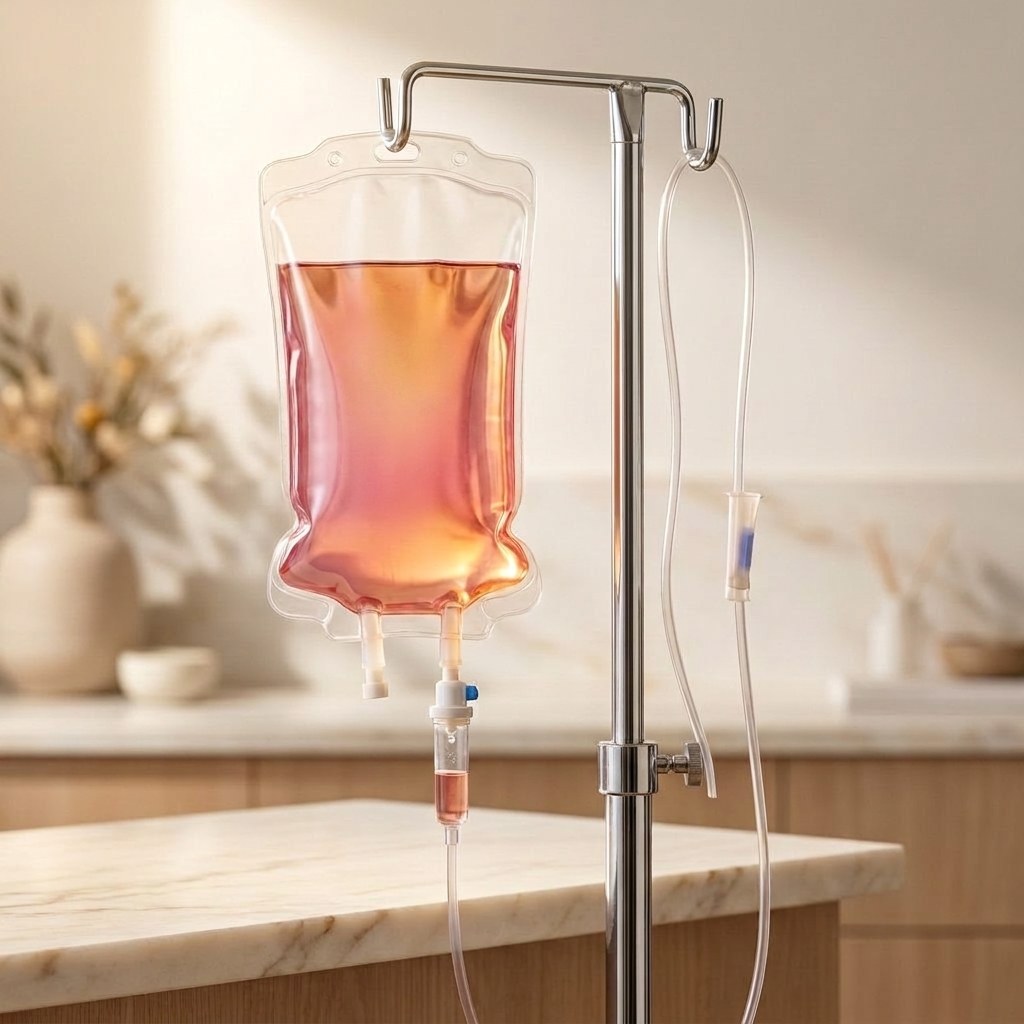
Intravenous delivery bypasses the gut. Whether that reaches the inside of your cells is the question the research is still working out.
- NAD+ is a coenzyme every cell needs to make energy, run its repair crews, and keep its DNA intact. Levels fall steadily across adult life, and in skin the drop is at least 50 percent.
- The decline is driven on two fronts: cells consume more NAD+ as an enzyme called CD38 ramps up and DNA damage piles up, while the machinery that recycles NAD+ slows down.
- Oral precursors NMN and NR reliably raise blood NAD+ in human trials and are safe over weeks to months. Hard clinical wins like better cognition or longer health span have not yet been shown.
- NAD+ IV therapy is safe in small studies but only lightly researched. Whether the infused molecule actually raises NAD+ inside your cells, rather than getting chewed up in the blood, is still an open question.
Somewhere in your forties, a molecule you have probably never heard of starts running low. It is called NAD+, and almost every cell in your body depends on it. It helps turn food into usable energy. It powers the crews that repair broken DNA. It keeps a family of longevity enzymes switched on. By the time you are middle-aged, the NAD+ in your skin has fallen by at least half compared to a newborn. That single fact is why NAD+ IV therapy has become one of the most talked-about treatments in longevity medicine. This article walks through why NAD+ and aging are so tightly linked, what NAD+ actually does inside a cell, and why some clinics deliver it through a vein instead of a capsule. It also stays honest about the part most marketing leaves out: what the human evidence does, and does not, yet prove.
What NAD+ Does Inside the Cell
NAD+ stands for nicotinamide adenine dinucleotide. The plus sign matters: it marks the form that is hungry to accept electrons. In its day job, NAD+ shuttles electrons through the reactions that pull energy out of glucose and fat and feed it into your mitochondria, the tiny engines that make ATP. Without enough NAD+, those engines sputter. The cell falls back on cruder, less efficient ways to make energy.
But NAD+ has a second, quieter job that turns out to matter just as much for aging. It is the fuel for three families of enzymes that do not just use NAD+, they spend it.
- Sirtuins. Often called longevity enzymes, sirtuins tune metabolism, the stress response, and the daily body clock. Every time one does its work, it burns a molecule of NAD+. When NAD+ runs low, sirtuins go quiet even if the cell has plenty of them on hand.
- PARPs. These are your DNA repair crews. When a strand of DNA breaks, PARP enzymes rush to the site and flag it for repair. The catalyst they use is NAD+. A single burst of heavy DNA damage can drain half or more of a cell's NAD+ in one go.
- CD38. A consumer with no off switch. CD38 chews through NAD+ as part of immune signaling, and as you will see, it is a prime suspect in why NAD+ falls with age.
So NAD+ is two things at once: the currency of cellular energy, and the currency of cellular maintenance. When it drops, both budgets get cut at the same time. Researchers have called that double hit an Achilles' heel of aging, because so many separate systems lean on the same molecule.
NAD+ levels decline during aging and may be an Achilles' heel, causing defects in nuclear and mitochondrial functions due to reduced sirtuin activity.
Imai & Guarente, Trends in Cell Biology, 2014
Why NAD+ Declines With Age
NAD+ decline is not a single broken part. It is supply and demand drifting apart. Think of NAD+ as water in a tank. Aging widens the drains and narrows the inflow at the same time.
On the demand side, the biggest culprit appears to be CD38. In aging mice, CD38 rises across the liver, fat, and muscle, and that rise tracks directly with falling NAD+. Mice engineered without CD38 hold onto their NAD+ and keep their mitochondria running well into old age. CD38 does something especially inconvenient: it also destroys NMN, the immediate building block of NAD+, which means it can blunt the very supplements people take to fix the problem.
The second drain is your own repair work. As DNA damage accumulates over decades, PARP enzymes fire more often, and each firing spends NAD+. Chronic, low-grade inflammation keeps both CD38 and PARP busy. The repair crews are doing their job. They are just expensive.
Then there is the inflow problem. Cells refill NAD+ mainly through a recycling route called the salvage pathway, run by an enzyme named NAMPT. In several tissues, NAMPT activity slips with age, so the tank refills more slowly. The exact balance varies by tissue and even by sex, but the overall picture is consistent across worms, mice, and human samples: NAD+ and aging move in opposite directions. In human skin, the drop is at least 50 percent across adult life. Spinal fluid shows a measurable decline after age 45.
Oral Precursors: What NMN and NR Actually Do in People
The obvious fix is to put NAD+ back. You cannot simply swallow NAD+, because it is a large, charged molecule that does not survive digestion intact. So the supplement world reaches for two precursors: nicotinamide mononucleotide (NMN) and nicotinamide riboside (NR). Both feed into the salvage pathway and get rebuilt into NAD+ inside the cell.
Here is where the evidence is genuinely good. In randomized human trials, these precursors do what they claim at the biochemical level. In a placebo-controlled trial in older adults, NR at one gram a day raised blood NAD+ by roughly 2.6-fold over ten weeks and was well tolerated. A multicenter NMN trial in healthy middle-aged adults found significant NAD+ increases at doses from 300 to 900 milligrams a day, with 600 milligrams looking like the sweet spot and no serious side effects.
Now the honest part. Raising a number in your blood is not the same as getting healthier. In that same NR trial, the participants had mild cognitive impairment, and after ten weeks their cognition had not measurably improved over placebo, even though their NAD+ had climbed sharply. The NMN trial reported some gains in physical performance, but the details were thin and the study was short. Across the field, the strongest human evidence is this:
- Oral NMN and NR reliably raise blood NAD+, often by twofold or more.
- They are safe and well tolerated over weeks to months at the doses studied.
- Proof that they slow disease, sharpen the mind, or extend health span in humans does not yet exist. Those claims remain hopeful, not established.
Why Some Clinics Use an IV Instead
If a pill raises blood NAD+ just fine, why run an infusion that takes an hour or more? The argument for NAD+ IV therapy is about the route. An IV skips the gut and the liver's first pass entirely. It pushes a large dose of NAD+ straight into the bloodstream, the thinking goes, flooding tissues faster and higher than any capsule could.
The thinking is reasonable. The biology is more stubborn. The most detailed human study, an infusion run by Grant and colleagues, delivered NAD+ over six hours and watched what happened. For the first two hours, blood NAD+ did not budge. The infused molecule was vanishing the instant it arrived, pulled out of the bloodstream or broken down before it could register. Plasma NAD+ only rose near the end of the infusion, and the metabolite trail suggested the enzymes that dismantle NAD+, including CD38, were doing exactly what they do best.
This is the crux of the bioavailability debate. NAD+ does not slip easily across the cell membrane. Most cells take in the smaller pieces, like nicotinamide and NMN, and rebuild NAD+ on the inside. So an IV may work less like topping up a tank and more like a delivery of raw parts that cells then have to reassemble. That can still be useful. But no human study has yet measured NAD+ inside tissues after an infusion, so whether IV NAD+ actually raises the level where it counts remains unproven.
The bottom line: NAD+ IV therapy is safe in the small studies done so far, and the science of NAD+ and aging is real and well understood. What is missing is proof that an infusion raises NAD+ inside your cells and produces a clinical benefit you can feel. The mechanism is strong. The human outcome data is still early.
What We Can Honestly Say Today
Strip away the marketing and a clear picture remains. NAD+ is central to aging biology, and that part is not in doubt. The molecule connects energy, DNA repair, and the longevity enzymes, and it falls with age through a mix of faster consumption and slower recycling. On that, the evidence is robust.
The interventions are where certainty thins out. Oral precursors clearly raise NAD+ and look safe in the short term, but the long-term, life-changing benefits people hope for have not been demonstrated. IV NAD+ is even earlier in its evidence: a handful of small studies on safety and pharmacokinetics, none yet showing durable effects on aging, energy, or disease. There is also a sensible note of caution, since NAD+ feeds cell growth, and the long-term safety of chronically pushing it higher has not been settled, especially for people at elevated cancer risk.
None of this means NAD+ does not matter. It means the science is moving faster than the proof, which is a normal and even healthy state for an active field. The most grounded view is that NAD+ restoration is a promising tool aimed at a real target, best understood as something still under study rather than a settled cure. Anyone considering it deserves that level of candor, because in longevity medicine the honest answer is usually more useful than the exciting one.
- Imai S, Guarente L. Trends in Cell Biology, 2014. Frames age-related NAD+ decline as an "Achilles' heel" of aging via reduced sirtuin activity. pubmed.ncbi.nlm.nih.gov/24786309
- Camacho-Pereira J, et al. Cell Metabolism, 2016. Shows CD38 rises with age and drives NAD+ decline and mitochondrial dysfunction; CD38-null mice are protected. pmc.ncbi.nlm.nih.gov/articles/PMC4911708
- Covarrubias AJ, et al. Nature Reviews Molecular Cell Biology, 2021. Comprehensive review of NAD+ metabolism, sirtuins, PARPs, and NADases in aging. pmc.ncbi.nlm.nih.gov/articles/PMC7963035
- Orr ME, et al. Aging (placebo-controlled NR pilot in MCI), 2024. NR (1 g/day, 10 weeks) raised blood NAD+ ~2.6-fold and was well tolerated, but cognition did not differ from placebo. pmc.ncbi.nlm.nih.gov/articles/PMC10828186
- Yi L, et al. Frontiers in Aging, 2022. Randomized dose-ranging NMN trial (300–900 mg/day, 60 days) safely raised blood NAD+, with 600 mg most effective. pmc.ncbi.nlm.nih.gov/articles/PMC9735188
- Grant R, et al. Frontiers in Aging Neuroscience, 2019. Pilot IV NAD+ infusion (3 µmol/min, 6 h): plasma NAD+ unchanged for the first 2 hours, indicating rapid clearance and metabolism. pmc.ncbi.nlm.nih.gov/articles/PMC6751327