How Hyperbaric Oxygen Therapy Works Inside the Body and what the evidence actually supports
Pressurize a room, hand someone pure oxygen, and the rules of how the body carries it quietly change. Here is the real mechanism, separated from the marketing.
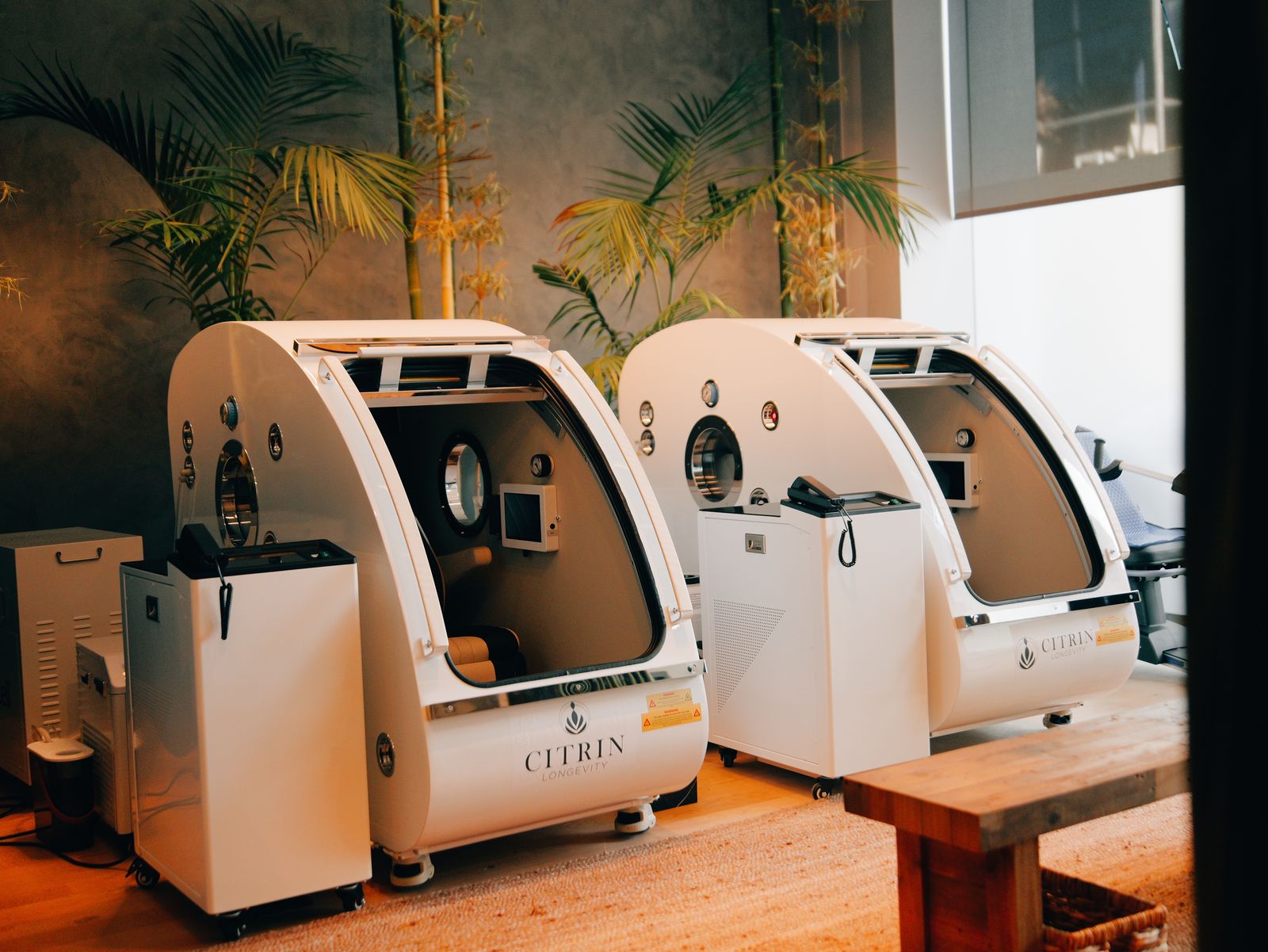
Clinical hyperbaric chambers deliver 100% oxygen at pressures of roughly 2 to 3 times sea level, the range where most of the documented benefits appear.
- Hyperbaric oxygen therapy works by pressure, not by adding more breaths. Under pressure, oxygen dissolves directly into your blood plasma, so it can reach tissue that normal circulation struggles to feed.
- That oxygen flood sets off real downstream biology: new blood vessel growth, calmer inflammation, stronger infection-fighting, and the mobilization of repair cells from bone marrow.
- The strongest evidence sits with a defined list of conditions, including non-healing wounds, radiation injury, and carbon monoxide poisoning. Anti-aging and recovery claims are promising but still early.
- Pressure has rules. The therapy carries real risks, from ear barotrauma to oxygen toxicity, which is why it belongs in a properly run chamber, not a wellness gimmick at 1.3 atmospheres.
You cannot breathe your way to more oxygen. Take ten fast breaths of room air and your blood barely notices, because the part of your blood that carries oxygen, hemoglobin, is already almost full at rest. This is the quiet limit most people never think about. Hyperbaric oxygen therapy exists to get around it. Seal a person inside a pressurized chamber, give them 100% oxygen to breathe, and a different rule takes over. Oxygen stops waiting for a ride on hemoglobin and starts dissolving straight into the watery part of the blood. Suddenly there is enough oxygen reaching places that poor circulation had written off.
That is the whole idea in one sentence. The interesting part is what the body does next, and where the science draws a firm line between what is proven and what is merely hopeful.
The physics: why pressure changes everything
Start with a law from a chemistry class you may have forgotten. Henry's law says the amount of a gas that dissolves into a liquid rises with the pressure of that gas above it. Open a soda and the pressure drops, the dissolved gas escapes, and it fizzes. Your bloodstream behaves the same way. Push the oxygen pressure up and more of it dissolves into your plasma.
The numbers make the point. Breathing ordinary air at sea level, your plasma carries only about 0.3 milliliters of dissolved oxygen per 100 milliliters of blood. Almost everything else rides on hemoglobin, which is already saturated. Now put that same person at 2 atmospheres absolute, roughly double sea-level pressure, breathing pure oxygen. Arterial oxygen pressure can climb past 1,400 mmHg, and dissolved oxygen rises to around 4 to 5 milliliters per 100 milliliters. The Undersea and Hyperbaric Medical Society notes this is enough to meet the basic oxygen needs of many tissues using plasma alone, even without working hemoglobin. Tissue oxygen levels can rise roughly tenfold.
Under hyperbaric conditions, enough oxygen can be dissolved in the plasma to keep tissue alive even when hemoglobin is unavailable. That is why it works for carbon monoxide poisoning, where hemoglobin is effectively blocked.
Undersea and Hyperbaric Medical Society, HBO Indications
Dissolved oxygen has an advantage that bound oxygen does not. It does not need a red blood cell to physically squeeze through a vessel to reach a cell. It diffuses. So in a swollen, poorly fed wound where capillaries sit too far from the cells that need them, the steep oxygen gradient created by pressure pushes oxygen across that gap. This is the core reason hyperbaric oxygen reaches tissue that standard oxygen, given through a mask at normal pressure, simply cannot.
The pressure level matters enormously, and this is where marketing gets slippery. Genuinely therapeutic protocols run between about 1.9 and 3.0 atmospheres. The UHMS states plainly that "mild" hyperbaric oxygen, delivered below 1.5 atmospheres in many wellness settings, is unproven. The physics are not on its side. At 1.3 atmospheres the gain in dissolved oxygen is a fraction of what real pressure produces.
What the oxygen flood actually does to your cells
Flooding hypoxic tissue with oxygen is not a passive event. It flips switches. Several of them are well documented.
- It grows new blood vessels. Hyperbaric oxygen raises vascular endothelial growth factor, or VEGF, the body's main signal for building new capillaries. In irradiated tissue, which is notoriously starved of blood supply, repeated sessions are one of the only interventions shown to actually increase vessel density.
- It calms inflammation. The therapy tends to lower pro-inflammatory signals like TNF-alpha and IL-1-beta while nudging up anti-inflammatory ones. It also reduces the tendency of neutrophils to stick to vessel walls, which limits the swelling and secondary damage that follow crush injuries and reperfusion.
- It sharpens the immune attack. White blood cells kill many bacteria using an oxygen-dependent "respiratory burst." Starve them of oxygen and that weapon weakens. Restore it and killing power returns. This is why oxygen is genuinely hostile to the anaerobic bacteria behind gas gangrene.
- It supports wound repair. Building collagen, the scaffold of healed tissue, literally requires oxygen as a chemical ingredient. Fibroblasts cannot lay down strong collagen in a hypoxic wound bed. Raise the oxygen and that machinery runs again.
There is a deeper twist that explains why the effects outlast the session. Researchers call it the hyperoxic-hypoxic paradox. When you cycle tissue between high oxygen and normal oxygen, the drop afterward registers, at the level of cell signaling, almost as if hypoxia had occurred. The body responds with the same repair and regeneration programs that low oxygen triggers, including HIF-1 and VEGF activation, but without ever actually starving the tissue. The brief returns to room air during a session, the "air breaks," are part of this rhythm.
The repair-cell and telomere research
Two lines of research pushed hyperbaric oxygen out of the wound clinic and into longevity conversations.
The first came from Stephen Thom and colleagues, published in the American Journal of Physiology. They found that a single two-hour session at 2.0 atmospheres roughly doubled the number of CD34+ stem and progenitor cells circulating in healthy volunteers. Over a course of 20 treatments, those cells rose about eightfold. In mice, the same effect vanished in animals engineered to lack a nitric oxide enzyme, which pinned down the mechanism: pressure and oxygen drive nitric oxide production in bone marrow, and that nitric oxide releases repair cells into the blood.
The second is the study that launched a thousand headlines. In 2020, Shai Efrati's group at Tel Aviv University published results in Aging on 35 healthy adults aged 64 and older. The protocol was demanding: 60 sessions over three months, five days a week, 90 minutes of pure oxygen at 2.0 atmospheres each, with short air breaks. Afterward, telomeres, the protective caps on chromosomes that shorten as we age, had lengthened by more than 20% in several immune cell types. The proportion of worn-out senescent cells fell by roughly 10% to 37%, depending on the cell type.
Read it carefully: The telomere study is genuinely striking, but it enrolled only 35 people and had no sham-treated control group. It measured cellular markers in blood, not lifespan or disease outcomes. It is a strong signal worth taking seriously and a reason for more research. It is not yet proof that hyperbaric oxygen reverses aging.
Where the evidence is strong, and where it is hype
This is the question that matters most, and the honest answer has two columns.
On the solid side sits a defined list of conditions the UHMS recognizes as standard of care, built on decades of clinical use and, for several, randomized trials. These include decompression sickness and gas embolism, severe carbon monoxide poisoning, gas gangrene and other necrotizing infections, crush injuries, compromised skin grafts and flaps, refractory bone infection, and selected non-healing wounds. The data here are real. A meta-analysis of 14 randomized trials found that adding hyperbaric oxygen to standard diabetic foot ulcer care improved healing and lowered amputation rates. A Cochrane review found it improves outcomes in late radiation injury, helping irradiated jawbone and tissue heal where little else works.
On the other side sit the uses that fill social media. Anti-aging, autism, routine athletic recovery, and general "wellness" exposures are not endorsed by the UHMS, either because the trials are small and mixed or because they barely exist. The aging research is early. The sports data are inconsistent: one analysis suggested faster recovery from genuine muscle injury, but no clear benefit for ordinary soreness. The pattern is not that these uses are impossible. It is that the proof has not caught up to the enthusiasm, and the loudest claims tend to come from the lowest, least effective pressures.
The risks pressure brings
Oxygen under pressure is a real intervention, which means it carries real risks. The most common is barotrauma. As pressure changes, the air spaces in your ears and sinuses have to equalize, and when they cannot, the result is pain or, rarely, a ruptured eardrum. This is usually preventable with the same techniques divers use.
Oxygen itself becomes toxic in high enough doses. Too much, for too long, can trigger seizures from central nervous system oxygen toxicity, which is exactly why protocols build in air breaks to keep the cumulative dose in check. Many people undergoing long courses also notice their vision shifting toward nearsightedness; it is typically reversible over the weeks after treatment ends. There is one absolute contraindication: an untreated collapsed lung, or pneumothorax, which pressure changes can turn life-threatening. And because pure oxygen feeds fire, the chamber environment demands strict rules about what goes inside, a point the FDA has emphasized in its safety guidance.
None of this argues against the therapy. It argues for doing it properly, at real pressures, with trained supervision, for reasons the evidence supports. Understanding how hyperbaric oxygen therapy works is the surest way to tell a genuine medical tool from a pressurized placebo.
- Hajhosseini B, Kuehlmann BA, Bonham CA, et al. StatPearls (NCBI Bookshelf), 2024. Reviews the physics of HBOT, including Henry's law, dissolved plasma oxygen, and oxygen toxicity. ncbi.nlm.nih.gov
- Undersea and Hyperbaric Medical Society. UHMS Hyperbaric Oxygen Therapy Indications, 2020. Defines approved indications, states that HBOT increases total blood oxygen content by roughly 125% at 2 ATA, and classifies mild (under 1.5 ATA) HBOT as unproven. uhms.org
- Thom SR, Bhopale VM, Velazquez OC, et al. American Journal of Physiology – Heart and Circulatory Physiology, 2006. HBOT doubled circulating CD34+ stem/progenitor cells after one session and increased them eightfold over 20 treatments via a nitric oxide–dependent pathway. pubmed.ncbi.nlm.nih.gov
- Hachmo Y, Hadanny A, Efrati S, et al. Aging (Aging-US), 2020. In 35 adults aged 64+, 60 HBOT sessions lengthened immune-cell telomeres by over 20% and reduced senescent cells by roughly 10–37%. aging-us.com
- Sharma R, Sharma SK, et al. Diabetology & Metabolic Syndrome / systematic review, 2022. Meta-analysis of 14 randomized trials found adjunctive HBOT improved diabetic foot ulcer healing and reduced amputation rates. pmc.ncbi.nlm.nih.gov
- U.S. Food and Drug Administration. FDA Letter to Health Care Providers: Safe Use of Hyperbaric Oxygen Therapy Devices, 2021. Defines HBOT and warns of risks from non-approved and mild uses, including fire hazard. fda.gov