Red Light Therapy and the Two Numbers That Decide Whether It Works 660 versus 850 — the wavelength is the whole story.
A panel of glowing diodes looks the same to the eye. To your cells, the difference between 660 nanometers and 850 is the difference between treating skin and reaching a joint. Here is the mechanism, the physics, and the evidence — without the hype.
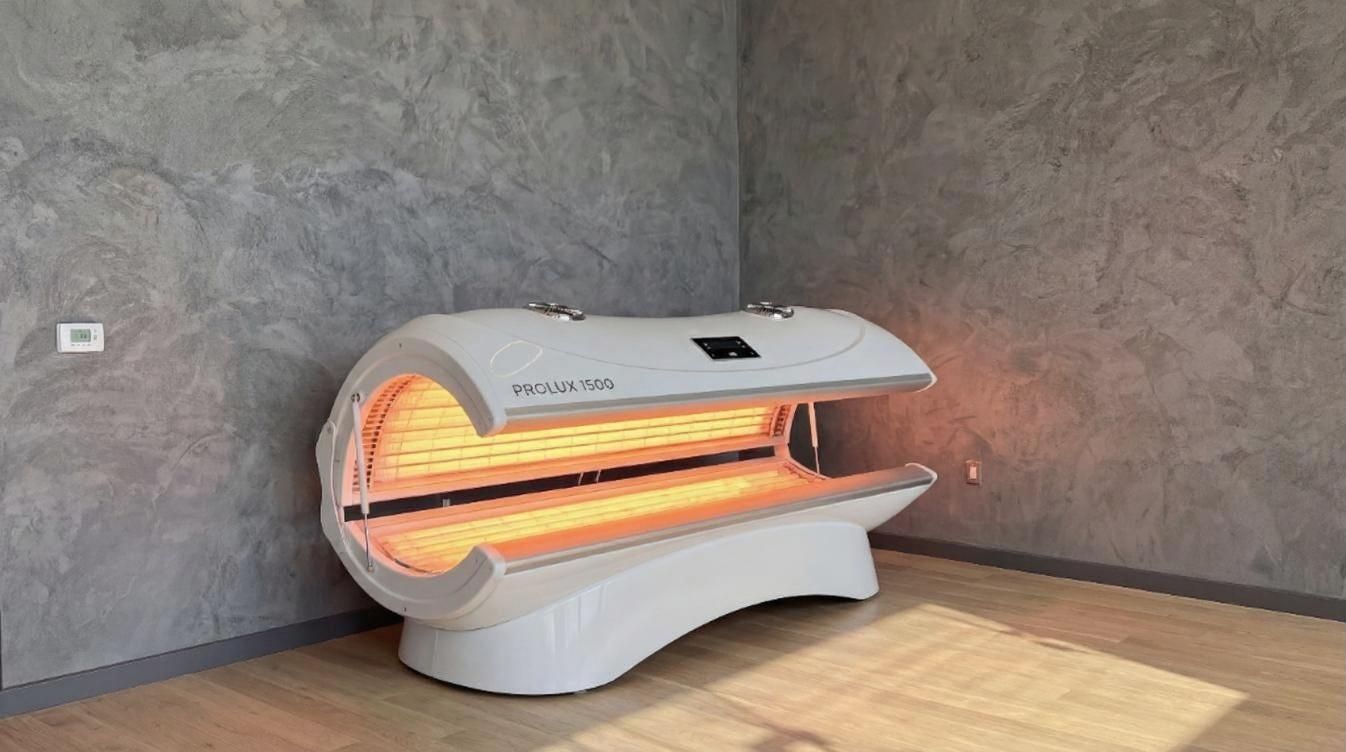
Red and near-infrared diodes look alike, but they stop at very different depths in the body. The wavelength — not the brightness — sets the target.
- Red light therapy works by feeding light to an enzyme inside your mitochondria — cytochrome c oxidase — which then makes more cellular energy (ATP). It is a photochemical effect, not heat.
- 660nm red penetrates only a few millimeters and is a skin-and-hair wavelength. 850nm near-infrared reaches centimeters deep, into muscle and joints. Most claims that confuse the two are confusing depth.
- More is not better. The benefit follows a biphasic dose-response curve: too little does nothing, the right dose stimulates, and too much can shut the effect off. Evidence is strongest for skin, hair, recovery, and joint pain.
Stand in front of a red light therapy panel and the experience is almost anticlimactic. There is a warm glow, a faint hum, and the vague sense that something photogenic is happening to your skin. What you cannot see is the actual event — which is occurring not on your skin but several layers beneath it, inside the energy factories of your cells. The marketing around red light therapy has run far ahead of most people’s understanding of it, which is a shame, because the underlying biology is both real and genuinely elegant. It also comes with hard limits. And almost every one of those limits comes down to two numbers printed on the box: the wavelengths the device emits. Usually 660 and 850. Understand what those numbers mean and you understand the entire field.
What red light therapy actually does inside a cell
Start with the part that sounds like science fiction but is, by now, fairly well established. Certain wavelengths of red and near-infrared light are not simply absorbed and turned into warmth the way sunlight on your forearm is. Instead, they are picked up by a specific molecule deep inside your mitochondria — the structures that generate almost all of your cellular energy. That molecule is an enzyme called cytochrome c oxidase, the fourth and final stop in the electron transport chain that produces ATP, the fuel every cell runs on.
Cytochrome c oxidase contains copper and iron centers that happen to absorb light strongly in two narrow bands — right around the red and near-infrared regions. When a photon of the correct wavelength strikes the enzyme, something useful happens. Under stress — inflammation, fatigue, aging, low oxygen — a molecule called nitric oxide tends to lodge itself onto that enzyme, clogging the spot where oxygen is supposed to bind. It throttles the engine. The light knocks the nitric oxide loose. Oxygen flows back in, electron transport speeds up, and the cell makes more ATP.
That is the core mechanism, and it is worth sitting with for a moment, because it explains nearly everything downstream. Red light therapy is not adding energy to your tissue in any meaningful caloric sense. It is removing a brake. The freed nitric oxide also relaxes nearby blood vessels, improving local circulation. And the brief, controlled rise in cellular signaling molecules that follows — reactive oxygen species, used here as messengers rather than damage — switches on genes involved in repair, collagen production, and inflammation control. This is why researchers sometimes describe the effect as an “exercise mimetic.” Like a hard workout, a well-dosed session is a small, productive stress that leaves the cell more resilient than it found it.
Light absorbed by cytochrome c oxidase photodissociates inhibitory nitric oxide, restoring electron transport and increasing ATP — the single event from which most of photobiomodulation’s effects flow.
de Freitas & Hamblin, IEEE Journal of Selected Topics in Quantum Electronics, 2016
Why 660nm and 850nm are not interchangeable
Here is where most consumer confusion lives. People treat “red light” as one thing. It is not. The two wavelengths printed on nearly every panel — 660 nanometers (visible red) and 850 nanometers (invisible near-infrared) — do fundamentally different jobs, and the difference is governed by simple physics.
Tissue is not transparent. As light travels into the body it is both absorbed by pigments like melanin and hemoglobin and scattered by the cellular matter it passes through. There is a narrow band of wavelengths — roughly 650 to 1,100 nanometers — where absorption and scattering both happen to dip, letting light travel deepest. Photobiologists call it the optical window. Both 660 and 850 sit inside it, but not in the same place, and that placement decides their reach.
- 660nm red light is strongly absorbed by melanin and hemoglobin near the surface. It penetrates only a few millimeters — realistically reaching the epidermis, the dermis, superficial blood vessels, and hair follicles. By 10 millimeters of depth, less than one percent of it remains. It is, in the most literal sense, a skin wavelength.
- 850nm near-infrared scatters less and is absorbed less by blood, so it slips deeper — on the order of centimeters into soft tissue. This is the wavelength that can actually reach a muscle belly, a tendon, or a knee joint, and it is the range used for transcranial and deep-recovery work.
- The dead zone in between matters too. Wavelengths around 700 to 770nm fall into a trough in the enzyme’s absorption and are comparatively inactive — which is exactly why well-designed devices cluster around 660 and 810–850 and skip the gap.
The practical takeaway is blunt. A 660nm-only mask is a reasonable tool for fine lines or scalp follicles and a useless tool for an arthritic knee, because the light physically cannot get there. An 850nm device aimed at deep tissue is overkill for a surface acne lesion. When a product promises to do everything, ask which wavelengths it emits — and at what depth its target actually sits. Penetration to the target at a meaningful intensity is the whole game.
The biphasic dose: why more light is not more benefit
If you take only one counterintuitive idea from this article, make it this one. Red light therapy does not obey “if some is good, more is better.” It follows a biphasic dose-response — what older literature calls the Arndt-Schulz curve. Below a minimum threshold, nothing happens; not enough photons reach the enzyme to matter. Within a sweet spot, you get stimulation: more ATP, more repair signaling. Push past that optimal dose and the curve bends back down. The same reactive oxygen species that signal repair at low levels begin to overwhelm the cell’s defenses at high ones, and the effect flattens or even reverses into inhibition.
This is not a fringe observation. In a landmark review, Huang and colleagues documented that ATP production, mitochondrial membrane potential, and cell proliferation all rise and then fall as the dose climbs — with the beneficial window for most tissues landing in the neighborhood of a few joules per square centimeter, while doses of 50 or more lost the benefit entirely. The unglamorous truth is that a great many disappointing studies and unsatisfied home users are not victims of a useless technology. They simply sat too close, too long, or not long enough — landing on the wrong part of the curve.
It also reframes how to think about a session. The goal is not maximum exposure. It is the right exposure, repeated consistently. A few minutes per area, a few times a week, generally beats marathon sessions. The dose that helps and the dose that does nothing are closer together than the marketing implies, and they sit on the same dial.
What the evidence actually supports
Stripped of hype, red light therapy has a real but bounded evidence base. It is strongest precisely where the physics cooperates — at the surface, where 660nm light does its work — and in a handful of deeper applications where 850nm can reach.
Skin and collagen
This is the most mature use. In a randomized, controlled trial, Wunsch and Matuschka treated 136 volunteers twice weekly and measured, with blinded photography and ultrasound, significantly improved skin complexion, reduced roughness, fewer fine lines, and measurably greater intradermal collagen density — with no adverse events. The mechanism is exactly the one above: light activates dermal fibroblasts, which lay down more collagen.
Hair
Androgenetic (pattern) hair loss is one of the few indications with formal regulatory backing. Multiple home-use red light devices have earned FDA clearance, and meta-analyses of sham-controlled trials show a real increase in hair density. The proposed mechanism is stimulation of stem cells in the follicle bulge, nudging dormant follicles back into their growth phase.
Recovery and pain
For muscle performance and recovery, near-infrared light applied before or after exercise has been shown to reduce markers of muscle damage and soreness and modestly improve output. For knee osteoarthritis, systematic reviews find statistically significant reductions in pain and disability — though the effect sizes are modest and the certainty of evidence is rated low to moderate, largely because trials used wildly inconsistent doses.
The bottom line: The mechanism is real, the wavelength determines the target, and the dose has a ceiling. Red light therapy is a legitimate tool for skin, hair, recovery, and joint pain — not a cure-all. When a claim reaches well beyond those areas, or treats “red light” as one undifferentiated thing, the marketing has outrun the data.
How to read a red light therapy claim
You now have the three questions that separate signal from noise. First, which wavelengths? 660nm for skin and hair; 850nm (or 810nm) for anything deeper than a few millimeters. A device that lists neither is asking you to trust it blindly. Second, what is the dose — and is it adjustable? Because of the biphasic curve, the protocol matters as much as the hardware; a panel with a sensible recommended distance and time is worth more than one that simply claims to be powerful. Third, does the claimed benefit match a tissue the light can actually reach? Surface effects are well-supported. The deeper and more systemic the promise, the more skepticism it earns.
None of this makes red light therapy magic, and that is rather the point. It is a specific intervention with a specific mechanism, real evidence in defined areas, and physical limits you can reason about. Once you can read the numbers on the panel, you are no longer at the mercy of the marketing — you are evaluating the same thing the researchers are.
- Hamblin, M.R. Photobiomodulation, Photomedicine, and Laser Surgery, 2018. Mechanisms and mitochondrial redox signaling in photobiomodulation — reviews how light absorbed by cytochrome c oxidase raises ATP and modest reactive oxygen species, driving repair and pre-conditioning effects. PubMed
- Huang, Y.-Y., Chen, A.C.-H., Carroll, J.D. & Hamblin, M.R. Dose-Response, 2009;7(4):358–383. Establishes the biphasic (Arndt-Schulz) dose-response: low doses stimulate while high doses lose or reverse the benefit. PubMed
- Avci, P., Gupta, A., et al. Seminars in Cutaneous Medicine and Surgery, 2013;32(1):41–52. Low-level laser (light) therapy in skin — reviews evidence for wrinkles, scars, and collagen via fibroblast activation. PubMed
- Wunsch, A. & Matuschka, K. Photomedicine and Laser Surgery, 2014;32(2):93–100. Randomized controlled trial: 660nm red-light treatment significantly reduced fine lines and roughness and increased intradermal collagen density in 136 volunteers. PubMed
- de Freitas, L.F. & Hamblin, M.R. IEEE Journal of Selected Topics in Quantum Electronics, 2016;22(3):348–364. Proposed mechanisms of photobiomodulation — details nitric oxide photodissociation from cytochrome c oxidase and the downstream signaling cascade. PubMed